
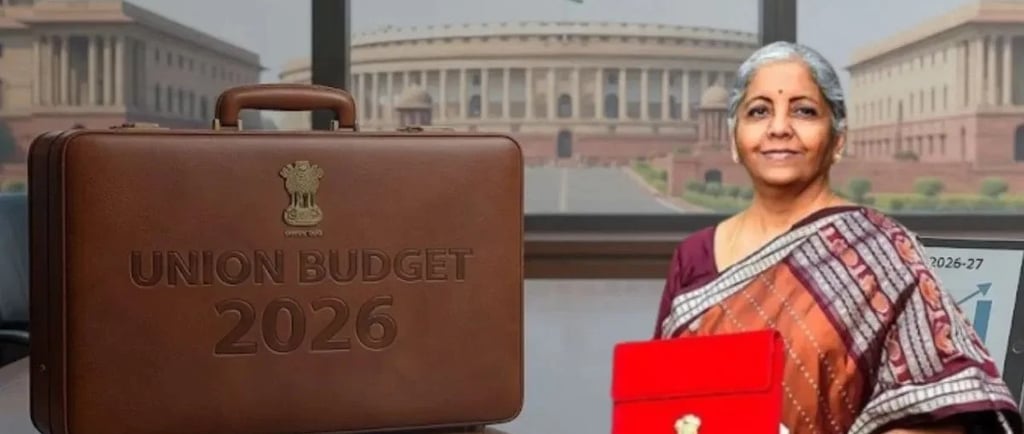
Union Budget 2026-27 of India: A Structural Growth Strategy Balancing Fiscal Discipline and Development
Ingrooww conducted the research about the Union budget 2026-27
2/3/20263 min read
Abstract
India’s Union Budget 2026-27 represents a calibrated fiscal framework designed to sustain growth momentum while maintaining macroeconomic stability. Anchored in infrastructure expansion, human-capital investment, tax reforms, and global integration, the Budget reflects a policy philosophy focused on productivity-driven development rather than short-term stimulus. This paper evaluates the fiscal strategy, sectoral allocations, macroeconomic implications, and structural reforms embedded in the Budget, highlighting its long-term impact on India’s economic trajectory.
1. Introduction
The Union Budget serves as India’s most important economic policy instrument, shaping fiscal priorities, sectoral development, and growth direction. The 2026-27 Budget arrives at a time when India is navigating global uncertainty alongside domestic growth opportunities. Policymakers have sought to balance expansionary development spending with fiscal prudence, ensuring that growth remains sustainable rather than inflationary.
2. Macroeconomic Context
India enters FY 2026-27 with relatively strong economic fundamentals:
Stable inflation compared to global peers
Strong foreign exchange reserves
Resilient domestic demand
Improving private investment sentiment
Growth projections for the upcoming fiscal year remain robust in the high-6% to low-7% range, reflecting continued momentum in manufacturing, services, and infrastructure activity.
3. Fiscal Strategy Framework
3.1 Fiscal Consolidation Path
The government continues its fiscal consolidation roadmap, targeting a deficit level around the mid-4% range of GDP. This signals commitment to macroeconomic stability and investor confidence.
3.2 Expenditure Quality Over Quantity
Rather than increasing overall spending indiscriminately, the Budget prioritises:
capital expenditure
infrastructure development
productivity-enhancing investments
Such an approach ensures that fiscal outlays generate multiplier effects rather than short-lived consumption spikes.
4. Capital Expenditure & Infrastructure Push
One of the defining features of Budget 2026-27 is its strong emphasis on infrastructure spending. High allocations to roads, railways, logistics, housing, and urban development aim to:
stimulate employment
crowd-in private investment
reduce logistics costs
improve supply-chain efficiency
Infrastructure investment has historically delivered one of the highest fiscal multipliers in India, making it a strategic instrument for growth.
5. Structural Reform Orientation
The Budget reflects a structural reform agenda rather than a populist policy approach.
Key reform directions:
simplification of tax administration
reduction in compliance burden
digitisation of governance
institutional transparency
Implementation of the Income-Tax Act 2025 framework from April 2026 marks a significant step toward tax rationalisation and reduced litigation.
6. Sectoral Policy Priorities
6.1 Manufacturing & Industrial Growth
The government aims to position India as a global manufacturing hub through incentives, export promotion, and ease-of-doing-business reforms. The strategy aligns with supply-chain diversification trends worldwide.
6.2 MSMEs
Small enterprises remain central to employment generation. Policy measures focus on:
easier credit access
regulatory simplification
digital integration
6.3 Agriculture & Rural Development
Rural income stability and agricultural productivity remain priorities through targeted schemes, input support, and infrastructure for value-added production.
6.4 Healthcare & Education
Enhanced allocations toward public health infrastructure, research, skill development, and digital education indicate strong emphasis on human capital formation.
6.5 Technology & Innovation
The Budget recognises digital infrastructure, artificial intelligence, and fintech as long-term growth drivers, encouraging public-private innovation ecosystems.
7. Trade & Global Integration
India’s expanding role in global trade partnerships is reflected in policy alignment with ongoing international trade negotiations. Export competitiveness is expected to be strengthened through:
logistics improvement
regulatory harmonisation
investment protection frameworks
digital trade facilitation
These measures position India as a reliable global economic partner.
8. Social Welfare & Inclusive Growth
Despite its reform orientation, the Budget maintains strong support for welfare programs and direct benefit transfers. This indicates a dual-track strategy:
long-term structural growth
short-term social protection
Such balance ensures economic expansion does not exacerbate inequality.
9. Policy Risks & Constraints
While the Budget is strategically balanced, several risks remain:
Global commodity price volatility
Exchange-rate fluctuations
Implementation bottlenecks in large infrastructure projects
External trade shocks
Effective policy execution and administrative coordination will determine actual outcomes.
10. Analytical Evaluation
Strengths
Strong infrastructure multiplier strategy
Balanced fiscal discipline
Reform-driven policy design
Investor-confidence signalling
Human capital emphasis
Limitations
Limited short-term consumption stimulus
Heavy reliance on execution capacity
Global dependency risks
11. Long-Term Economic Implications
If implemented effectively, Budget 2026-27 could:
enhance India’s productivity growth trajectory
accelerate formalisation of the economy
strengthen global competitiveness
improve infrastructure efficiency
generate sustainable employment
The Budget therefore functions not merely as an annual financial statement but as a medium-term development blueprint.
12. Conclusion
India’s Union Budget 2026-27 represents a carefully calibrated fiscal strategy that prioritises long-term growth over immediate political gains. Its emphasis on infrastructure, institutional reforms, human capital, and global integration reflects a mature policy approach aimed at transforming India into a high-productivity, investment-driven economy.
Rather than relying on short-term stimulus, the government has chosen a path of structural strengthening. If execution matches policy intent, the Budget could serve as a foundational step toward India’s long-term development ambitions.
Contact
Reach Out for the Market consultant and Property Investmemt.
Phone
contact@ingrooww.com
+91 9316868115
© 2025. All rights reserved.
SEBI REG.NO: INA100001695